Guides
DNC Compliance for Businesses: How to Build a Responsible Do Not Call Program
A company can scrub every lead file it receives and still have a weak Do Not Call compliance program.
That happens when the National DNC check works, but a sales rep reimports an older spreadsheet. Or when a consumer tells one agent to stop calling, the request reaches the CRM, but the dialer keeps using yesterday's list. Or when a business expands into another state without realizing its federal process does not answer every state-specific requirement.
The problem is treating DNC compliance as a database lookup instead of an operating system.
For businesses conducting outbound calling, a responsible DNC program needs to address National Registry screening, company-specific do-not-call requests, applicable state requirements, consent and exemptions, lead-source controls, staff procedures, documentation, system synchronization and ongoing auditing.
What Is DNC Compliance for a Business?
DNC compliance is the set of policies, data controls, procedures and technology a business uses to prevent prohibited telemarketing contact and honor consumers' do-not-call choices. It can involve the National Do Not Call Registry, company-specific suppression requests, staff training, list maintenance, records, state requirements and other applicable calling rules.
That is broader than DNC scrubbing.
Scrubbing answers a specific question:
Did this phone number match the DNC data being checked?
A compliance program has to answer a much larger question:
Should this business allow this particular contact into this particular outbound campaign right now?
Those are not equivalent decisions.
For example:
National DNC result = not flagged
does not automatically establish:
eligible_to_call = true
Other conditions may still need to be evaluated.
A useful contact-governance model looks more like:
Lead received
→ identify source
→ validate/normalize phone data
→ National DNC control
→ internal suppression control
→ applicable state requirements
→ consent/exemption evaluation where relevant
→ campaign/calling-method rules
→ eligible outbound queue
For a deeper explanation of the actual lookup process, see the companion Complete Guide to DNC Scrubbing.
What Are the Core Parts of a DNC Compliance Program?
A practical DNC compliance program generally needs controls for National Registry access and list freshness, company-specific do-not-call requests, written procedures and training, state-law review, consent or exemption documentation, vendor oversight, suppression synchronization, recordkeeping and periodic auditing.
The exact requirements depend on what the business does, but the federal safe-harbor framework itself demonstrates why a scrub alone is not enough.
FTC guidance says the Telemarketing Sales Rule's Do Not Call safe harbor for inadvertent errors depends on practices including written procedures, personnel training, maintaining an entity-specific DNC list, using National Registry data accessed no more than 31 days before the call, maintaining records of that process, monitoring compliance and showing that the prohibited call resulted from error.
That gives outbound businesses a useful principle:
Compliance should be designed around a repeatable process, not an occasional file cleanup.
1. Understand Your National Do Not Call Registry Responsibilities
For covered telemarketing, businesses generally need to register for access to the National Do Not Call Registry, subscribe to the relevant area-code data and ensure calling lists are screened using sufficiently current Registry information.
The FTC states that covered sellers must pay any required fee for the area codes they call and receive a Subscription Account Number, or SAN. A telemarketer or service provider can access Registry information on the seller's behalf using the seller's SAN, but each seller must have its own appropriate subscription.
This creates an important vendor-management issue.
Imagine a mortgage company purchases leads from Vendor A and is told:
“These leads were already DNC scrubbed.”
That statement does not answer several questions the mortgage company should care about:
When was the check performed?
Which Registry data was used?
Who performed the screening?
Was the appropriate seller's Registry subscription involved?
Has the list been sitting unused for two months?
Were any contacts subsequently suppressed internally?
A vendor's previous check is useful information.
It should not become a substitute for the buyer understanding its own obligations.
How fresh must the National DNC data be?
The FCC's current rule describes a process employing a version of the National Do Not Call Registry obtained no more than 31 days before the call, and FTC guidance uses the same 31-day standard.
Operationally, that means list status should be treated as time-sensitive data.
A lead does not permanently inherit a “safe” status because someone checked it during acquisition.
That is especially important for:
aged leads;
reactivated campaigns;
old CRM exports;
campaign clones;
recovered database backups; and
lead files purchased long before they are actually called.
DNCSweeper currently states that its DNC database is refreshed daily and that valid U.S. numbers are checked against its daily-updated DNC database based on the U.S. FTC Registry.
That can help teams perform the DNC-checking portion more frequently, but the organization's broader Registry-access responsibilities still need to be evaluated independently.
2. Maintain a Company-Specific or Internal DNC Process
The National Registry is not the only Do Not Call list that matters.
A consumer can tell your company to stop calling even if the phone number does not appear on the National Registry.
FCC rules require covered callers to maintain procedures for company-specific do-not-call requests. The rule requires a written policy, training for personnel involved in telemarketing, recording a request when it is made, and honoring the request within a reasonable time that may not exceed 10 business days. The FCC rule currently requires the do-not-call request to be honored for five years.
This is where many otherwise organized outbound teams fail.
The issue is rarely that nobody recorded the request.
The issue is that the suppression happened in only one place.
For example:
Consumer says “don't call me”
→ agent marks DNC in CRM
→ CRM blocks future sales tasks
That looks correct.
But if the same number still exists in:
a dialer campaign,
a marketing automation system,
an older CSV,
a subaccount,
a lead-routing platform, or
another salesperson's contact database,
the organization can still contact the consumer.
A stronger process is:
Consumer DNC request
→ centralized suppression record
→ CRM suppression
→ dialer suppression
→ campaign exclusion
→ future-import protection
→ audit trail
The internal DNC record should survive a new lead import.
A suppressed contact should not become active merely because an older CSV is uploaded again.
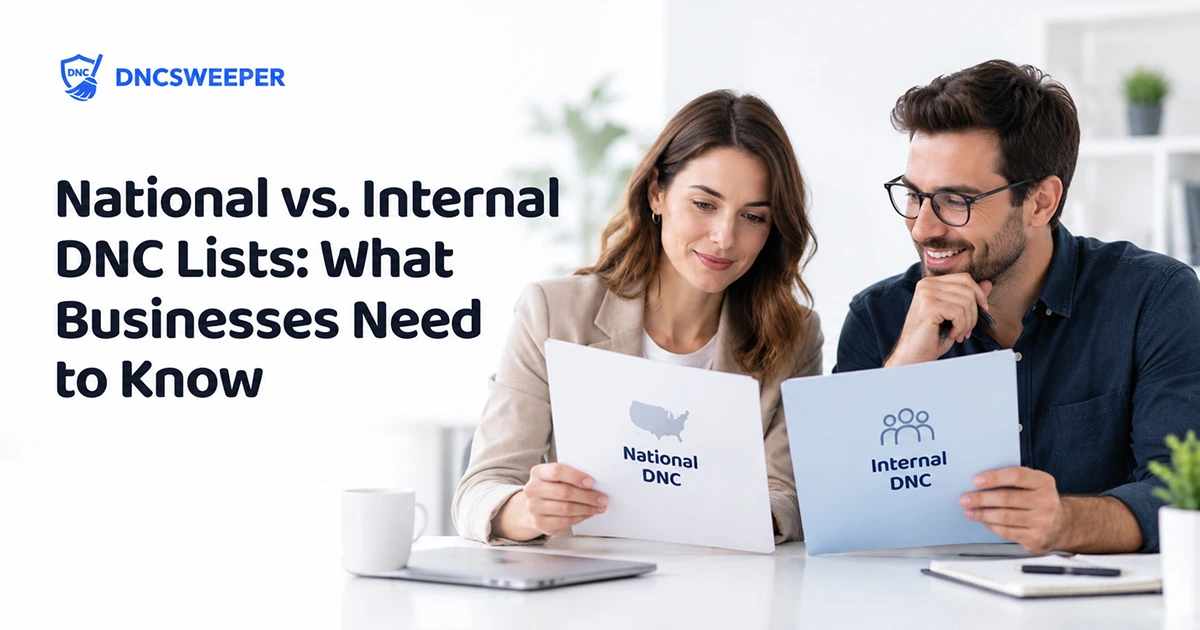
For a deeper treatment of these two distinct systems, see National vs. Internal DNC Lists.
Suggested Graphic 1 — National vs. Internal DNC Controls
Purpose: Show that National Registry screening and company-specific suppression are parallel controls rather than interchangeable databases.
Suggested alt text: “DNC compliance diagram showing National Do Not Call Registry screening and company-specific do-not-call suppression feeding an outbound eligibility decision.”
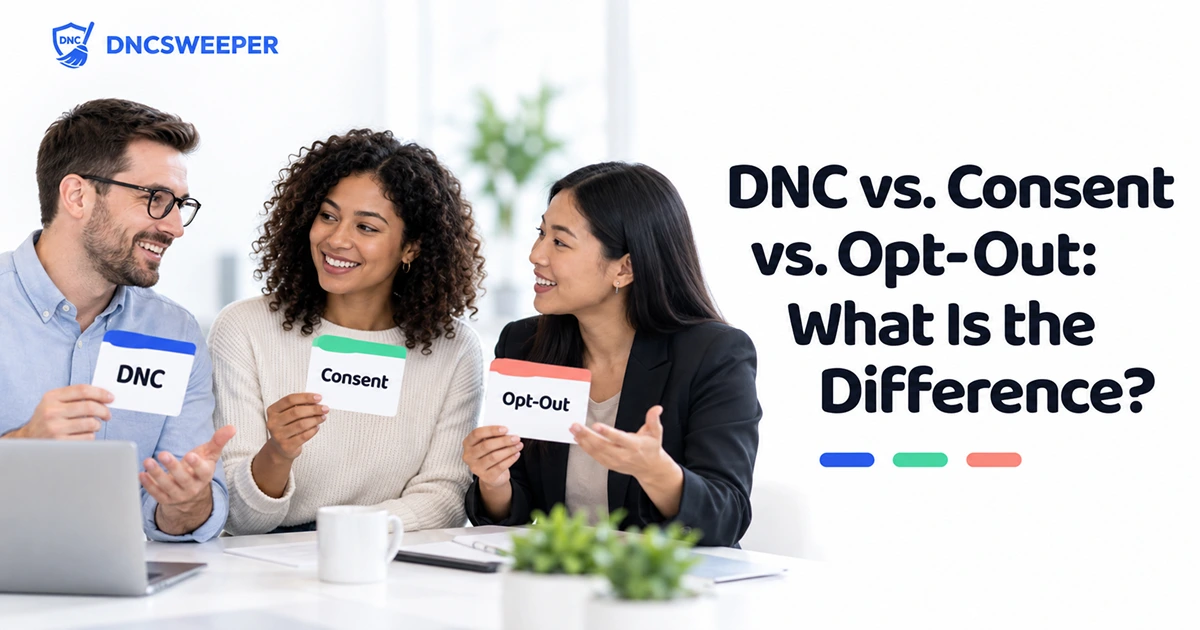
3. Do Not Treat DNC, Consent and Opt-Out as the Same Data Field
Three different ideas frequently get compressed into a CRM field called “contactable.”
That is dangerous.
|
Concept |
Question it answers |
Example |
|
National DNC status |
Does the number appear in the DNC data being checked? |
Registry lookup returns a match |
|
Internal DNC status |
Has this consumer asked this organization not to call? |
Consumer tells an agent to stop calling |
|
Consent |
Has the consumer provided permission relevant to the particular contact? |
Documented authorization for a specified type of outreach |
|
Exemption |
Does a specific legal exception potentially apply? |
A qualifying established business relationship under the relevant rule |
The FTC's Telemarketing Sales Rule includes circumstances in which written permission or an established business relationship may permit certain calls to someone whose number is on the National Registry.
Under the federal TSR framework, an established business relationship can generally arise from a qualifying transaction within the preceding 18 months or an inquiry/application within the preceding three months. But if the consumer asks that particular company not to call, the entity-specific request overrides the EBR for that company's calls.
That means this logic is unsafe:
Has EBR → ignore all DNC data
A better design stores the relevant facts separately:
national_dnc_status
internal_dnc_status
consent_status
consent_source
consent_timestamp
relationship_type
relationship_date
campaign_type
last_eligibility_check
Then an eligibility process can apply the rules that actually matter to the campaign.
Consent requirements also vary depending on factors such as the calling technology, prerecorded or artificial voice use, the nature of the communication and other circumstances. They should not be reduced to a generic checkbox.
For the full distinction, see DNC vs. Consent vs. Opt-Out.
4. State Rules Can Add Another Compliance Layer
Federal DNC compliance does not automatically resolve every state telemarketing requirement. Some states maintain separate DNC programs, licensing or registration requirements, different exemptions, calling restrictions or other rules that businesses contacting residents of those states may need to evaluate.
There is no responsible way to build a nationwide program by creating one federal rule set and assuming it works everywhere.
Florida illustrates why.
The Florida Department of Agriculture and Consumer Services maintains a separate Florida Do Not Call List. Its business guidance explicitly says that purchasing the National list does not eliminate the need to purchase the state list where required. Florida also separately regulates certain telemarketing businesses through licensing requirements.
Colorado similarly maintains telemarketer-registration requirements and separately notes obligations connected to its No-Call program.
Texas maintains a state no-call framework that is updated quarterly and contains its own definitions, requirements and exceptions.
The operational lesson is more important than memorizing three states:
State must become a compliance attribute.
If the organization calls nationally, the workflow may need to determine the consumer's applicable jurisdiction before the outbound decision is finalized.
That can influence:
registry screening;
registration or licensing;
calling windows;
exemptions;
consent requirements;
recordkeeping; and
other campaign restrictions.
Do not assume a product that performs a National DNC lookup automatically evaluates all of those questions.
DNCSweeper currently states explicitly that it returns whether a number is on the DNC data it checks and does not expose separate federal, state or DMA layer flags in the product today.
That limitation should remain part of the compliance architecture.
5. Define Exactly What a “Clean” Result Means
A green status can create more risk than a red status if the team interprets it incorrectly.
DNCSweeper currently categorizes successfully processed batch numbers into outcomes including DNC and Clean, while invalid and errored records are separated for review. Its current documentation describes the lookup as returning whether a number is on the Registry data being checked.
Therefore, in a compliance program:
Clean = not flagged by that DNC lookup.
It should not become:
Clean = legally approved for every outbound call or text.
A “Clean” number may still require evaluation for:
internal DNC requests;
applicable state requirements;
consent;
campaign type;
calling technology;
calling hours; or
other applicable TCPA, FCC, FTC or state-law requirements.
This is why database naming matters.
Prefer:
dnc_status = clean
over:
legal_to_contact = yes
The second field claims far more than the DNC lookup actually established.
6. Build Controls Around Lead Vendors and Purchased Data
Lead-source compliance is one of the largest operational blind spots.
An insurance organization might buy 25,000 leads on Monday.
The spreadsheet arrives with columns for:
name;
phone number;
state;
lead date;
source; and
a vendor field labeled “TCPA compliant.”
Operations uploads it directly into the dialer.
The problem is that “compliant” is not useful unless the buyer knows what process produced that label.
Vendor oversight should investigate questions such as:
How was the lead generated?
When was it generated?
What permission was captured?
Which seller was identified?
When was DNC screening performed?
How are opt-outs handled after the lead is sold?
Can the vendor provide supporting records?
What happens when a number is resold to multiple buyers?
An FTC enforcement example involving third-party lead generation illustrates the underlying issue: consumers appearing on a lead list did not necessarily create an established business relationship with the specific company that later purchased or used those leads.
A better operational process is:
Vendor lead
→ preserve source evidence
→ normalize phone data
→ perform your current DNC control
→ internal suppression check
→ verify relevant permission/exemption
→ jurisdiction/campaign controls
→ eligible dialer list
DNCSweeper can handle the DNC-screening portion of that sequence through batch uploads of CSV, XLS or XLSX files. It automatically normalizes U.S. numbers where possible and preserves the original uploaded columns in its exported workbook.
Preserving fields such as lead source and record ID is useful because the compliance result remains connected to the record that produced it.
7. Put the Compliance Check Before the Outbound Queue
Many companies technically have the correct tools but put them in the wrong order.
Weak workflow
Website lead
→ CRM
→ automatic dialer enrollment
→ DNC check
By the time the check happens, the number has already been granted contact eligibility.
Better workflow
Website lead
→ normalize
→ DNC check
→ internal suppression
→ other required eligibility checks
→ eligible
→ CRM/dialer campaign
DNCSweeper's Check API is designed for one-number-at-a-time lookups from a CRM, dialer or application. Its response includes the normalized phone number, a DNC boolean/status, source information and a timestamp.
That makes the API useful as one pre-eligibility control.
The important design principle is not simply “use an API.”
It is:
Call the API before the system grants outbound eligibility.
For large uploaded lists, DNCSweeper supports another pattern:
Upload
→ DNC processing
→ review DNC/Clean/Invalid/Error results
→ export
→ apply remaining controls
→ outbound system
It also supports signed batch.completed webhooks so another application can be notified when a batch finishes rather than requiring an employee to repeatedly check processing status.
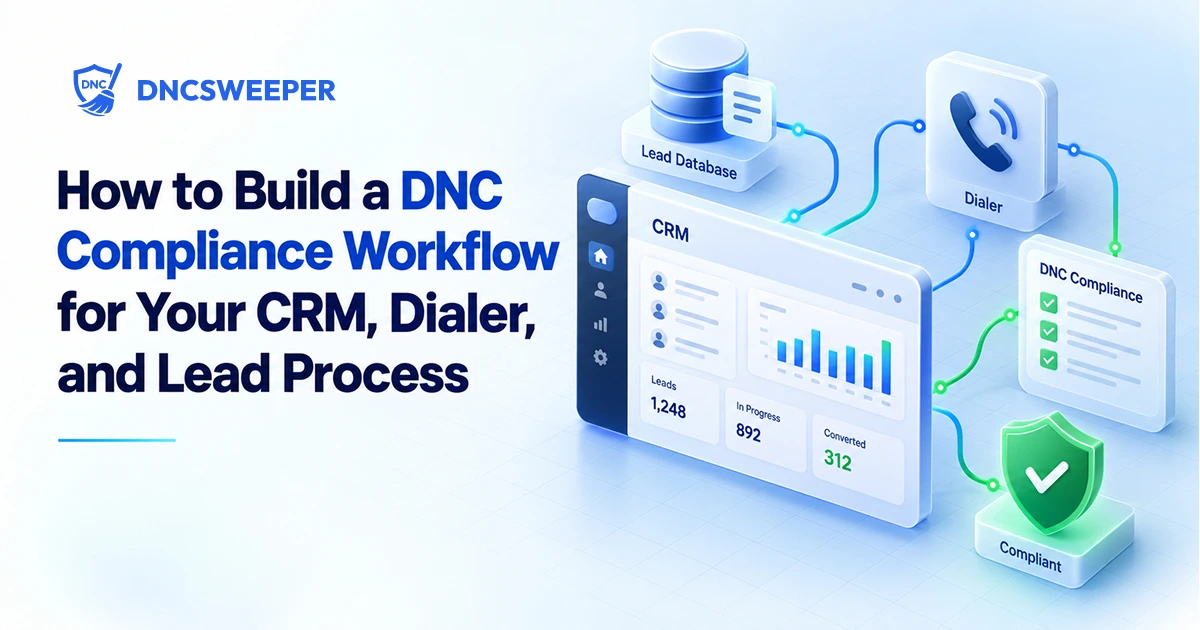
Suggested Graphic 2 — DNC Compliance Gate
Purpose: Demonstrate where DNC screening should sit in a CRM/dialer architecture.
Suggested alt text: “Outbound compliance workflow placing DNC screening, internal suppression and eligibility controls before contacts enter the dialer.”
8. Assign Responsibility Instead of Assuming “Compliance Handles It”
A policy without owners becomes an archive document.
A workable DNC program should define who owns specific controls.
|
Responsibility |
Typical owner |
|
Regulatory interpretation |
Legal / compliance |
|
Registry subscription |
Compliance / operations |
|
Batch DNC screening |
Operations |
|
Internal suppression architecture |
Engineering / CRM operations |
|
Agent handling of DNC requests |
Sales / call-center leadership |
|
Consent record integrity |
Marketing operations / compliance |
|
Vendor evidence |
Procurement / compliance |
|
API and workflow enforcement |
Engineering |
|
Periodic testing |
Compliance / QA |
|
Record retention |
Compliance / legal / data operations |
Small companies may combine several roles.
That is fine.
The important point is that someone can answer:
Who owns this control?
If the answer is “everyone,” the operational answer is often “nobody.”
9. Train the People Who Can Break the Workflow
The FCC requires personnel engaged in telemarketing to be informed and trained in the existence and use of the organization's do-not-call list. FTC safe-harbor guidance also identifies personnel training as a core condition.
Training should therefore cover what agents actually encounter.
For example:
A consumer says, “Take me off your list.”
An agent should not debate whether the person means the National Registry.
The agent needs to know how to record the company-specific request.
A manager should understand why exporting “all contacts” from the CRM can reintroduce suppressed records.
Operations should know why an invalid or errored DNC lookup should not automatically be treated as clean.
Developers should know that disabling a compliance API because it increases latency can change the eligibility control.
Training should map to the real workflow rather than being limited to a yearly legal presentation.
10. Build Records That Let You Reconstruct What Happened
A mature compliance program should be able to answer a simple question months later:
Why did our system believe this contact was eligible when the call occurred?
That requires more than the current value of a CRM checkbox.
The FTC's 2024 TSR amendments expanded telemarketing recordkeeping. Current FTC guidance states that covered records generally must be retained for five years and includes records concerning call details, people who asked the telemarketer to stop calling, consent, established business relationship claims, service providers and the version of the Do Not Call Registry accessed.
Operationally useful records can include:
the phone number;
DNC result;
check timestamp;
registry/process version information;
lead source;
internal DNC status;
consent evidence where relevant;
campaign;
seller identity;
outbound system;
agent;
opt-out history; and
decision result.
DNCSweeper currently provides batch and API usage history and recent Check API activity, including whether some results came from cache.
That visibility can support operations, but businesses should not assume a SaaS dashboard automatically satisfies their complete regulatory retention obligations.
Design the retention system around the legal requirements that apply to the organization.
11. Audit the Process, Not Just the Policy
The FTC's safe-harbor guidance specifically refers to monitoring and enforcing written DNC procedures.
That means the question is not:
Do we have a DNC policy?
It is:
Does the process behave the way the policy says it behaves?
An effective audit can test samples.
Take 100 recently dialed records.
For each one, ask:
Was the DNC check current?
Was the internal DNC list checked?
Did the contact enter through an approved workflow?
Was the lead source retained?
Was any claimed exemption supported?
Was the applicable state considered?
Can the business reconstruct the eligibility decision?
Then perform the reverse test.
Take several numbers already on the internal suppression list.
Attempt to:
import them through CSV;
add them manually;
push them through an API;
clone an older campaign; and
assign them to another sales rep.
If one of those paths makes the number callable again, the compliance architecture has a bypass.
That test often reveals more than reading the policy document.
A Practical DNC Compliance Checklist
Before launching or materially changing an outbound program, confirm that:
-
The business has identified which federal and state requirements apply to the campaign.
-
Appropriate National DNC Registry registration, subscriptions and SAN processes are maintained where required.
-
National Registry screening uses sufficiently current data.
-
A written company-specific DNC policy exists and is actually implemented.
-
Agents know how to capture do-not-call requests immediately.
-
Internal suppression reaches every CRM, dialer and campaign path that can initiate contact.
-
A consumer cannot be reactivated simply by reimporting an old file.
-
DNC status is stored separately from consent and other eligibility data.
-
Applicable state DNC, registration, licensing and calling restrictions have been evaluated.
-
Purchased leads are independently reviewed rather than accepted solely because a vendor calls them “compliant.”
-
Invalid and failed DNC checks are quarantined instead of assumed to be clean.
-
Batch and real-time controls occur before contacts enter active outbound queues.
-
Compliance responsibilities are assigned to actual owners.
-
Staff receive workflow-specific training.
-
Records are sufficient to reconstruct what the organization checked and why it made the contact decision.
-
The system is periodically tested for bypasses and synchronization failures.
This checklist is intentionally broader than “scrub the file.”
That is the point.
Suggested Graphic 3 — DNC Compliance Program
Purpose: Summarize the major controls that surround DNC scrubbing.
Suggested alt text: “DNC compliance program including National Registry screening, internal DNC suppression, consent, state rules, staff training, vendor controls, records and auditing.”
Frequently Asked Questions About DNC Compliance
Does DNC scrubbing make a business TCPA compliant?
No. DNC screening addresses one portion of a broader regulatory environment. TCPA/FCC rules can also involve consent, calling technology, artificial or prerecorded voices, company-specific DNC procedures and other requirements. State rules may add further obligations.
How often should businesses scrub their calling lists?
For covered federal calls, the process must use a version of the National Registry obtained no more than 31 days before the call. Businesses may choose to check more frequently as an operational control.
Does a business need an internal DNC list if it already uses the National Registry?
Yes, where the company-specific DNC rules apply. A consumer can ask the particular business not to call even if the number is absent from the National Registry. FCC rules separately require procedures for recording and honoring those requests.
How quickly must a company honor an internal DNC request?
Under the current FCC company-specific DNC rule, requests must be honored within a reasonable time not exceeding 10 business days. The request must currently be honored for five years.
Can an established business relationship allow a call to someone on the National Registry?
The federal TSR provides an EBR exception in certain circumstances, generally involving qualifying transactions within 18 months or inquiries/applications within three months. But an entity-specific request not to call overrides that EBR for the company's calls, and other rules may still apply.
Does written permission matter if a number is on the National Registry?
The TSR provides a written-permission exception when its requirements are met, including authorization for the specific seller and the telephone number that may be called. Other consent rules can apply depending on the calling method.
Are business phone numbers covered by the National Do Not Call Registry?
The FTC states that the National Registry is for personal telephone numbers and does not cover business phone numbers. That does not mean all B2B outreach is automatically exempt from every federal or state telemarketing requirement.
Do state DNC rules matter if a company follows the National Registry?
Potentially, yes. States can impose separate DNC, telemarketing-registration, licensing or other requirements. Florida, Colorado and Texas are examples of jurisdictions with their own state-level structures.
Can a company rely on its lead vendor's DNC screening?
A vendor's screening can be part of the process, but businesses should understand their own Registry-access obligations, the freshness of the screening and the evidence supporting the lead. FTC guidance makes clear that seller and telemarketer responsibilities cannot simply be ignored because a third party participates in the campaign.
Can DNC compliance be automated?
Parts of it can. DNC lookups, internal suppression, eligibility rules and workflow enforcement can all be automated. But automation must reflect the correct rules and data sources. DNCSweeper currently supports batch DNC screening, a real-time Check API and signed batch-completion webhooks for the DNC-checking portion of the process.
Build a Compliance Program That Survives Real Operations
DNC compliance breaks at the handoffs.
The vendor hands a file to operations.
Operations uploads it into the CRM.
The CRM sends records to the dialer.
An agent records an opt-out.
Someone exports the database.
Another employee reimports an older version three months later.
A responsible compliance program controls those transitions.
DNCSweeper can make the Registry-checking portion of that system more repeatable: upload CSV, XLS or XLSX lists for batch processing, review DNC, Clean, Invalid and Error outcomes, preserve source columns in the export, check individual numbers through the API, or use a signed webhook to trigger downstream automation when a batch finishes.
But the DNC result should remain exactly what it is: one eligibility control.
Internal do-not-call requests, consent, state-specific obligations, campaign rules, vendor governance and other applicable requirements still need their own controls.
The goal is not to be able to say:
“We scrub our lists.”
The better question is:
“Can we explain how a contact became eligible, what we checked, when we checked it, and how we prevent that decision from being bypassed?”
That is the foundation of a more responsible DNC compliance program.