Guides
DNC vs. Consent vs. Opt-Out: What Is the Difference?
A number can pass a DNC check and still be the wrong number to contact.
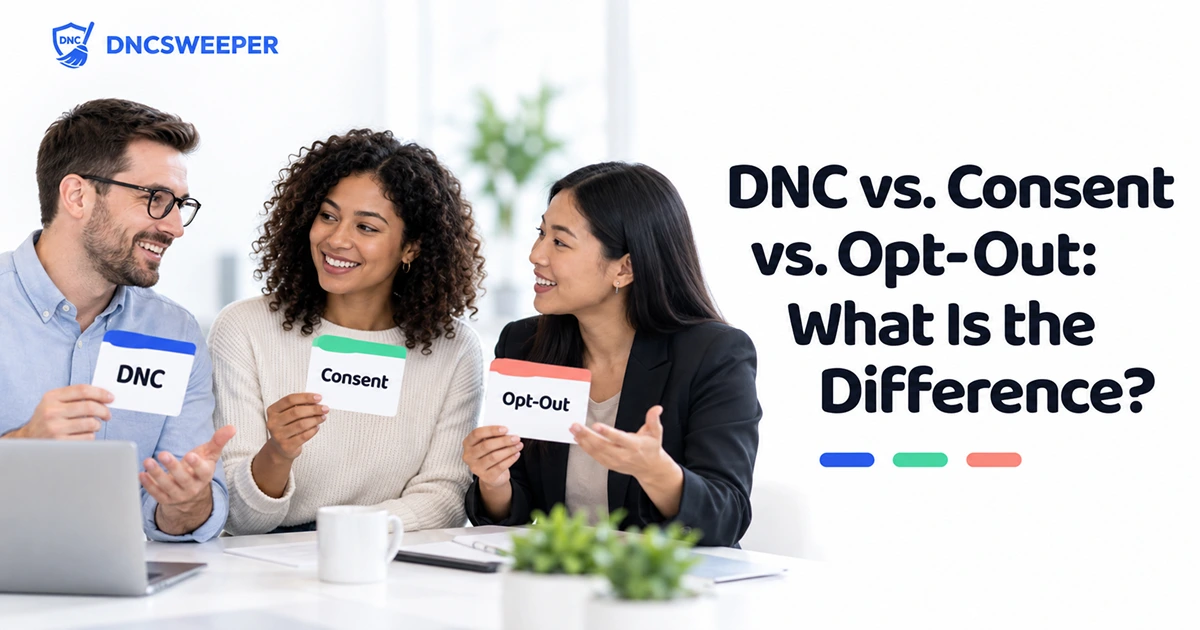
That happens because DNC status, consent, and opt-out requests answer different questions.
A DNC lookup asks whether a number appears in the Do Not Call data being checked. Consent concerns whether a person has given permission that may support a particular type of call or text. An opt-out happens when that person later communicates that certain contact should stop.
Outbound teams get into trouble when those three facts are collapsed into one field such as contactable = yes.
A lead can be clean on the National Registry but have no consent for the communication method being used. A consumer can have previously consented and then revoke that consent. A number can pass a fresh registry check while remaining blocked on the company's own suppression list.
The practical goal is therefore not to determine whether a contact is simply “good” or “bad.” It is to understand which permission and suppression controls apply before the communication is sent.
What Is the Difference Between DNC, Consent, and Opt-Out?
DNC status tells you whether a number appears in an applicable Do Not Call registry or suppression source. Consent records permission that may authorize a particular communication. An opt-out is a person's instruction to stop certain communications. These concepts interact, but passing one check does not automatically satisfy the others.
The distinction becomes much easier when each concept is turned into a question.
DNC status:
“Is this number suppressed by the DNC source I am checking?”
Consent:
“What has this person actually authorized us to do?”
Opt-out:
“Has this person subsequently told us to stop?”
Those three questions need separate answers.
|
Concept |
What it means |
What triggers it |
What it tells the business |
What it does not prove |
|
DNC status |
Whether a number appears in the DNC registry or suppression source being evaluated |
Registry registration or another applicable suppression event |
Whether that DNC control flagged the number |
That every other legal requirement permits or prohibits contact |
|
Consent |
Permission or authorization relevant to a particular communication |
Consumer agreement or another legally recognized form of permission |
What communication may be permitted under the applicable rule |
That the permission remains effective forever or covers every channel/campaign |
|
Opt-out |
Consumer instruction to stop certain contact |
STOP response, verbal request, web request, another reasonable revocation method, or other applicable mechanism |
That previous permission/contact preference may need to be suppressed or revoked |
The consumer's National DNC Registry status |
The central rule for operations teams is simple:
A DNC result answers one question. It does not automatically answer every consent, revocation, opt-out, or contact-permission question.
Suggested Graphic 1 — DNC vs. Consent vs. Opt-Out
Purpose: Give readers a three-column conceptual comparison before discussing legal and operational details.
Suggested alt text: “Comparison of DNC status, consumer consent, and opt-out requests in an outbound calling and texting workflow.”
What Is DNC Status?
DNC status indicates whether a phone number was identified by the Do Not Call source being checked. For example, a National DNC lookup can determine whether the number appears on the federal Registry. A clean result should not be interpreted as universal permission to call or text that person.
The FCC prohibits covered telephone solicitations to residential subscribers whose numbers appear on the National Do Not Call Registry, subject to specified exceptions. Its current rule requires the relevant screening process to use National Registry data obtained no more than 31 days before the call.
That is the role of a DNC lookup.
Suppose an MCA company receives a spreadsheet containing 30,000 prospects.
The business might process it like this:
Lead file
→ normalize phone numbers
→ DNC lookup
→ DNC / clean / invalid / error
→ other eligibility controls
→ outbound queue
DNCSweeper currently supports the DNC-checking portion of that workflow. It accepts CSV, XLS, and XLSX files, normalizes U.S. phone numbers where possible, provides live batch progress, and categorizes results as DNC, Clean, Invalid, or Error. Its exports preserve the original uploaded columns.
The key word is portion.
DNCSweeper's current documentation says each valid U.S. number is checked against its daily-updated DNC database based on U.S. FTC Registry data. The product does not currently expose separate federal, state, or DMA-layer flags.
It also does not claim that a DNC check verifies consent or your company's internal suppression history.
What does “Clean” mean?
For DNCSweeper, a Clean result should be interpreted narrowly:
The number was not returned as DNC by the lookup performed.
It does not automatically mean:
“This business has legal permission to contact this person in every circumstance.”
A company may still need to evaluate internal do-not-call requests, consent, state requirements, campaign type, calling technology, calling hours, and other applicable rules.
That distinction is important enough to preserve in your actual data model.
Prefer:
national_dnc_status = clean
over:
legal_to_call = true
The second field makes a conclusion the DNC lookup did not make.
For the mechanics of registry screening itself, see the companion Complete Guide to DNC Scrubbing.
What Is Consent?
Consent is evidence that a person has authorized a particular type of communication under circumstances where permission matters. The required form and scope of consent can vary based on the type of call or text, the technology used, whether the communication is telemarketing, and the specific rule involved.
Consent is not one universal checkbox.
Current FCC rules, for example, require prior express written consent for specified telemarketing calls using an automatic telephone dialing system or artificial or prerecorded voice. The regulation defines prior express written consent as a signed written agreement containing required authorization and disclosures.
FTC rules also recognize written permission as an exception to National Do Not Call restrictions in qualifying circumstances. The FTC explains that the agreement must be affirmative and specific to the seller and phone number involved.
This produces an important nuance:
Being on the National DNC Registry does not always end the analysis
Suppose:
National DNC = Yes
but the consumer has provided qualifying written permission to receive calls from that particular seller.
Federal rules contain permission-based exceptions that may affect the analysis.
That does not justify a CRM rule that says:
consent = yes → ignore all DNC controls
Why?
Because the claimed consent still has to be valid, relevant, documented, applicable to the communication being made, and not revoked.
Other legal requirements may also apply.
A better database structure separates the evidence:
consent_status
consent_type
consent_source
consent_timestamp
consent_language_version
phone_number_consented
seller
campaign_or_use_case
revoked_at
This turns consent into evidence rather than a vague marketing tag.
What Is an Opt-Out?
An opt-out is a person's instruction that certain communications should stop. Depending on the circumstances, that request may operate as a revocation of consent, a company-specific do-not-call request, or another suppression instruction. The business should record both what the consumer requested and the scope of the resulting suppression.
This is where terminology gets messy.
A consumer may say:
“Stop texting me.”
“Do not call me again.”
“Remove me from your marketing list.”
“STOP.”
Those phrases may interact with different regulatory rules depending on the communication.
Under the FCC's current consent-revocation rule, a called party may revoke prior express consent or prior express written consent for covered calls or texts using any reasonable method that clearly expresses a desire not to receive further calls or texts. The regulation specifically recognizes reply-text terms including “stop,” “quit,” “end,” “revoke,” “opt out,” “cancel,” and “unsubscribe” as per se reasonable methods.
Covered revocation requests must be honored within a reasonable time not exceeding 10 business days.
Separately, FCC company-specific DNC rules require covered telemarketers to record a consumer's request not to receive calls from that entity when the request is made and honor it within a reasonable time not exceeding 10 business days. Those company-specific DNC requests must currently be honored for five years.
That is why an opt-out should not be stored merely as:
consent = false
You may need to know what the person opted out of, when, how, and for which entity or communication category.
Is an Opt-Out the Same as Revoking Consent?
Not necessarily in every operational or legal context, although the two often overlap.
If a consumer who previously consented to a covered robotext replies STOP, that response can revoke the consent supporting future covered messages.
If a consumer on a live telemarketing call says “Don't call me again,” that can create a company-specific DNC request that must be reflected in the caller's suppression process.
The resulting operational record should capture the actual event:
Channel: SMS
Request: “STOP”
Received: September 2, 2026, 2:14 PM
Original permission: Marketing SMS
Resulting suppression: Marketing SMS consent revoked
Other applicable suppression: Evaluate under company-specific DNC and current FCC scope rules
Do not convert every consumer preference into one unexplained global boolean.
Does One Opt-Out Automatically Stop Every Call and Text?
Not always. The scope of an opt-out depends on the applicable rule and circumstances. As of September 2, 2026, an FCC requirement that would make certain consent revocations automatically extend from one type of informational message to unrelated robocalls and robotexts is under a temporary waiver until January 31, 2027.
This is a particularly important current-law detail.
The FCC adopted rules in 2024 addressing the scope of TCPA consent revocation. However, the Commission later delayed part of the rule concerning the requirement to apply a revocation made in response to one type of informational message across unrelated future robocalls and robotexts.
In January 2026, the FCC extended that limited waiver through January 31, 2027 while it considers whether the broader cross-category rule should be modified.
The waiver does not eliminate the general obligation to recognize reasonable revocation methods or the current 10-business-day requirement for covered revocations.
Operationally, this means companies should avoid two bad extremes:
Too narrow:
“We only honor STOP if the consumer uses our exact keyword.”
Too broad without analysis:
“Any opt-out in any context permanently blocks every possible communication from every business unit.”
Instead, record the request faithfully and apply the appropriate current rule to its scope.
Six Scenarios That Show Why These Concepts Must Stay Separate
Scenario 1: Number not on National DNC + no documented consent
An insurance lead passes a National DNC lookup.
DNC = Clean
Operations then assumes:
Eligible = Yes
That conclusion may be premature.
If the intended call or text requires a particular form of consent because of the technology or campaign being used, a clean DNC result does not manufacture that consent.
DNC check: passed
Consent requirement: unresolved
Decision: continue eligibility review
Scenario 2: Number on National DNC + claimed consent
A mortgage company receives a lead whose number appears on the National Registry.
The vendor says:
“The lead consented.”
Federal rules contain permission-based exceptions, but the company should be able to establish the permission that it is relying on. FTC guidance for the DNC written-permission exception requires express written agreement for calls from the specific seller and includes the relevant telephone number.
The responsible question is not:
“Did the vendor mark consent = true?”
It is:
“What permission do we actually have, who received it, what did it authorize, and can we prove it?”
Scenario 3: Number clean yesterday + consumer opts out today
Yesterday:
National DNC = Clean
Today:
Consumer replies:
STOP
Yesterday's clean DNC result remains a record of what the National DNC lookup returned at that time.
But it does not erase today's revocation.
The consumer's current instruction must feed the appropriate suppression process.
This is why “last DNC check” and “last consumer preference change” should be separate timestamps.
Scenario 4: Consumer directly tells the company to stop calling
A real-estate agent speaks with a prospect who says:
“Don't call this number again.”
The National Registry might still return Clean tomorrow.
That does not negate the company-specific request.
FCC rules require covered telemarketers to maintain procedures for company-specific DNC requests, record the request when made, and honor it within the applicable timeframe.
For the deeper distinction, see National vs. Internal DNC Lists.
Scenario 5: Lead vendor claims consent but the buyer cannot document it
A lead-generation vendor sends:
consent = TRUE
but provides no disclosure language, timestamp, capture method, or evidence tying the consumer to the permission.
That is an operational weakness.
The business relying on consent should know what evidence supports that decision rather than treating a vendor's spreadsheet column as conclusive proof.
Consent is strongest operationally when the organization can reconstruct:
who → agreed to what → for whom → at which number → when → through what interface
Scenario 6: Number passes DNC check but appears on internal suppression
A call-center list goes through DNCSweeper.
Result:
Clean
The same phone number exists in the company's CRM as:
Internal DNC = Yes
The correct operational result is:
Suppress.
The Registry lookup and company-specific suppression are different controls. DNCSweeper's current published functionality does not claim to replace a company's internal DNC database.
DNC Status, Consent, and Opt-Out Should Not Share One CRM Field
A CRM field called:
DNC = yes/no
looks simple.
In reality, it may hide four different events:
The phone number is on the National Registry.
The consumer told the company not to call.
The consumer revoked prior consent.
The consumer opted out of SMS marketing.
If those events are collapsed together, the business loses important context.
A more useful model is:
|
Field |
Example |
|
National DNC status |
Clean |
|
National DNC checked at |
2026-09-02 09:14 |
|
Internal DNC |
Yes |
|
Internal DNC requested at |
2026-08-14 15:22 |
|
Consent status |
Revoked |
|
Consent type |
Marketing SMS |
|
Consent originally captured |
2026-05-03 |
|
Revocation method |
STOP reply |
|
Revoked at |
2026-08-14 15:21 |
|
Source system |
CRM |
|
Last eligibility decision |
Suppressed |
Now the organization can understand why the record is suppressed.
That is much more defensible than:
contactable = no
Where DNCSweeper Fits
DNCSweeper solves the DNC-checking part of this decision model.
For batch data, the current workflow can be:
CSV/XLS/XLSX
→ phone normalization
→ DNC lookup
→ DNC / Clean / Invalid / Error
→ internal suppression
→ consent/revocation evaluation
→ other applicable checks
→ outbound eligibility
DNCSweeper preserves original uploaded columns in the exported workbook, which is useful if fields such as CRM ID, consent date, lead source, or internal suppression status already exist in the input file.
For individual leads, DNCSweeper's Check API can perform a DNC lookup before the record enters the next stage of a workflow. The product also supports signed batch.completed webhooks so another system can react after processing finishes.
A stronger real-time architecture is:
New lead
→ DNC Check API
→ internal suppression
→ consent evaluation
→ applicable state/campaign checks
→ eligible
→ CRM/dialer
Not:
New lead
→ dialer
→ send/call
→ check eligibility later
The API should participate in an eligibility decision before contact—not merely document what happened afterward.
Suggested Graphic 2 — Contact Eligibility Decision
Purpose: Show DNC status, consent, and suppression as independent gates.
Suggested alt text: “Outbound eligibility workflow checking DNC status, internal suppression, consent, and opt-out history before allowing calls or text messages.”
Common Operational Mistakes
Treating consent as permanent
Consent may later be revoked.
The consent record therefore needs both an acquisition state and a current state.
Treating a DNC scrub as consent verification
DNCSweeper does not claim to verify consent. A clean DNC lookup does not establish consent.
Deleting opted-out contacts instead of suppressing them
If the record disappears completely, an old vendor file or CRM import may re-create the person as a supposedly new lead.
A suppression record allows the business to recognize that number when it returns.
Processing STOP in the SMS platform but nowhere else
An opt-out stored only with the messaging provider can become invisible to another system.
The organization needs rules for how revocations and company-specific DNC requests propagate according to their scope.
Letting sales reps manually override suppression
A field such as:
Override = customer interested
should not silently undo a recorded DNC request or consent revocation.
Re-permission should follow whatever process is legally appropriate for the communication involved.
Checking eligibility after campaign enrollment
A contact that is already sitting inside an active outbound queue can be called before downstream compliance logic catches up.
Eligibility controls belong before activation.
A Practical Pre-Contact Decision Framework
Before an outbound communication is released, ask:
-
What type of communication is this?
Live call, prerecorded/artificial voice, automated text, manual message, informational communication, or telemarketing? -
What DNC controls apply?
National Registry, internal/company-specific DNC, state requirements, or another applicable suppression source? -
What does the DNC result actually say?
Do not translate “not flagged” into “legally approved.” -
Does this communication require consent or another permission basis?
-
What consent evidence exists?
Who consented, to what, for whom, when, and for which number? -
Has anything happened since consent was captured?
STOP response, verbal DNC request, email revocation, CRM preference update, or another reasonable revocation method? -
What is the scope of that request under the current rules?
-
Have all relevant systems received the suppression decision before the communication is sent?
This is the broader process discussed in How to Build a DNC Compliance Workflow.
Frequently Asked Questions:
Is DNC status the same as consent?
No. DNC status reflects whether a number appears in a DNC registry or suppression source. Consent is evidence of permission relevant to a particular communication. One does not automatically establish the other.
Does being off the National DNC Registry mean I can call someone?
Not automatically. Being absent from the Registry resolves only that specific registry question. Consent requirements, internal DNC requests, state laws, calling technology, time restrictions, and other rules may still apply.
Can someone consent to calls even if their number is on the National DNC Registry?
Federal rules include permission-based exceptions in qualifying circumstances. For example, FCC and FTC rules recognize specified written permission that can affect National DNC restrictions. Whether an exception applies depends on the actual permission and circumstances.
Does consent override an internal DNC request?
Do not assume so. Under current FCC rules, a seller-specific DNC request terminates an established business relationship for telemarketing purposes. A company-specific suppression request should be evaluated independently of prior relationship or consent records.
What happens when someone opts out?
The business should record the request, determine its scope under the applicable rule, update the relevant consent or suppression status, and prevent covered future communications within the required timeframe. For covered FCC consent revocations made by reasonable means, the current maximum is 10 business days.
Is replying STOP the only way to revoke consent to text messages?
No. Current FCC rules recognize several specified reply keywords as automatically reasonable, but they also require other language to be honored when a reasonable person would understand it as a revocation request. Other reasonable methods may also qualify.
Does a STOP text automatically stop every type of communication from a company?
Do not assume that universally. The FCC has temporarily waived through January 31, 2027 the portion of its rule that would automatically extend certain revocations made in response to one type of informational message across unrelated future robocalls and robotexts. Other revocation and DNC obligations remain in place.
Can a clean DNCSweeper result prove that a consumer consented?
No. DNCSweeper's current product performs DNC lookups. Its documentation does not state that a Clean result verifies consumer consent.
Should opted-out contacts be deleted from the CRM?
Operationally, deletion can create reimport problems. Maintaining an appropriate suppression record lets the organization recognize the consumer again if an old list or another data source reintroduces the number.
Does DNC scrubbing alone make a company TCPA compliant?
No. DNC screening is one compliance control. FCC rules separately address consent, revocation, artificial/prerecorded voice calls, calling practices, company-specific DNC requests, and other requirements.
The Better Question Is Not “Can We Contact This Number?”
Outbound systems often want one answer:
Yes or No?
But a good eligibility process first asks why.
What did the DNC lookup return?
What permission do we have?
Has that permission been revoked?
Has the consumer told our company to stop?
What other rules apply to this campaign?
Only then should the workflow decide whether the contact moves into the outbound queue.
DNCSweeper can make the DNC portion repeatable through CSV and Excel batch scrubbing, live result categorization, real-time Check API lookups, exports, and completion webhooks.
It should not be asked to answer questions the lookup was never designed to answer.
A Clean result is a DNC result.
Consent is permission evidence.
An opt-out is a new instruction from the consumer.
Keeping those concepts separate—and then connecting them in the right order—is what turns a collection of compliance fields into a workable contact-governance process.