Guides
National vs. Internal DNC Lists: What Businesses Need to Know
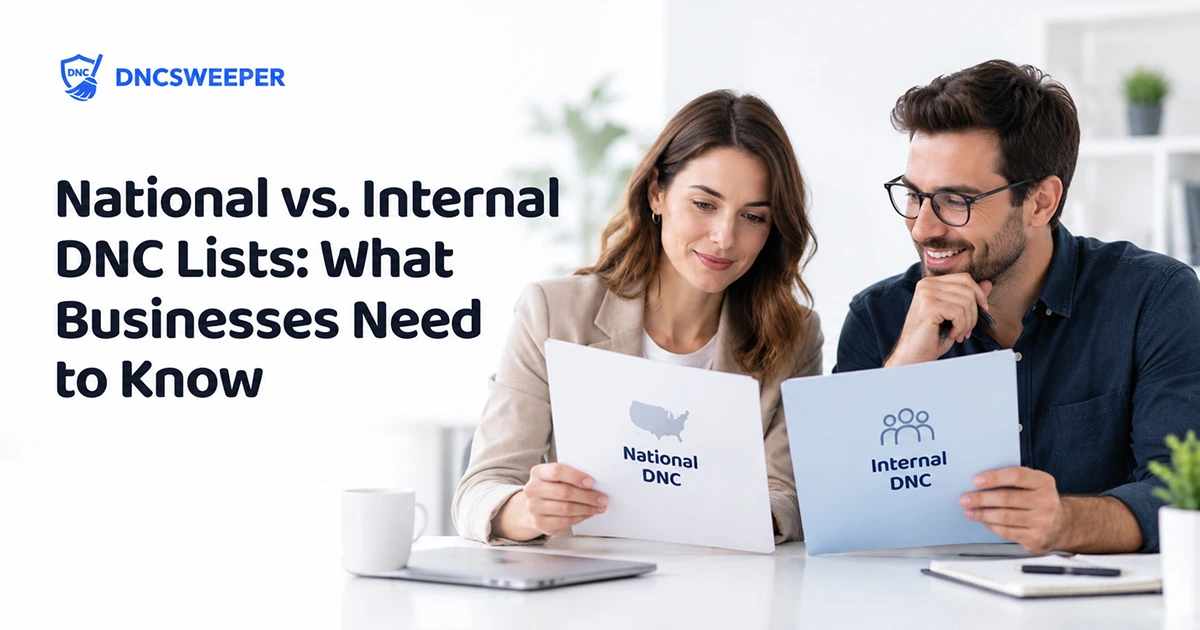
A sales team can scrub every number against the National Do Not Call Registry and still call someone who has already told that company, “Stop calling me.”
That happens because the National Do Not Call Registry and an internal Do Not Call list are not the same list.
The National Registry is an external federal registry that covered outbound programs check before making calls. An internal—or company-specific—DNC list is created from requests made directly to a particular business. The first tells you something about a number's federal registry status. The second records what that consumer has told your organization.
Confusing the two creates an operational gap. A number may be absent from the National Registry but still be suppressed internally. And a successful National DNC scrub does not erase a company-specific request.
This guide explains who controls each list, what puts a number on it, how long the status matters, how businesses should use both, and how to keep internal suppression from disappearing between CRMs, dialers, spreadsheets and vendors.
What Is the Difference Between the National DNC Registry and an Internal DNC List?
The National Do Not Call Registry is a federal registry of phone numbers consumers register to reduce covered telemarketing calls. An internal DNC list is maintained by a particular business and contains numbers of people who have directly asked that business not to call them. A responsible outbound process may need to check both.
The easiest way to understand the difference is this:
National DNC:
“Do not send covered telemarketing calls to this number generally.”
Internal DNC:
“Your company specifically has been told not to call this number.”
The FTC describes these as separate protections. Its Telemarketing Sales Rule guidance prohibits covered calls both to numbers on the National Registry and to consumers who have asked not to receive further calls from or on behalf of a particular seller.
The FCC rules likewise address the National Registry in 47 CFR §64.1200(c) and company-specific do-not-call procedures separately in §64.1200(d).
That distinction should also exist in your database.
Do not reduce both states to one generic field such as:
dnc = yes/no
A stronger data model separates them:
national_dnc_status
national_dnc_checked_at
internal_dnc_status
internal_dnc_requested_at
internal_dnc_source
Those fields describe different facts.
National DNC vs. Internal DNC: Side-by-Side Comparison
|
Aspect |
National Do Not Call Registry |
Internal / Company-Specific DNC List |
|
Who maintains it? |
Federal government |
The individual business or seller |
|
How does a number get added? |
Consumer registers the phone number with the National Registry |
Consumer asks the particular business not to call |
|
Who controls the source data? |
Federal Registry administrator |
The business receiving the request |
|
Whom does it generally affect? |
Covered telemarketers subject to the National DNC rules, subject to applicable exceptions |
Calls made by or on behalf of the particular entity the consumer told to stop calling |
|
Must the consumer also be on the National Registry? |
Not applicable |
No |
|
Does National scrubbing automatically check it? |
Yes, if the scrubber is checking National Registry data |
No |
|
How fresh should screening be? |
Current FCC rules use National Registry data obtained no more than 31 days before the call for the relevant process |
The request should become part of the company's suppression process when received |
|
How long does the status last? |
FCC rules say National registrations are honored indefinitely until cancelled or removed by the database administrator |
Current FCC rules require a company-specific request to be honored for five years |
|
Can an established business relationship matter? |
It can affect certain National DNC restrictions where the applicable requirements are satisfied |
A seller-specific DNC request terminates the EBR for telemarketing purposes under current FCC rules |
|
Primary operational control |
Registry scrubbing |
First-party suppression |
|
Main failure mode |
Using stale or unchecked calling data |
Request recorded in one system but ignored by another |
The current FCC rule states that National DNC registrations must be honored indefinitely unless the registration is cancelled or the number is removed by the database administrator. The same rule requires the National Registry data used in the relevant calling process to be no more than 31 days old.
For company-specific requests, the FCC requires covered callers to record the request when it is made, honor it within a reasonable period not exceeding 10 business days, and maintain the request for five years.
These are different data lifecycles because they solve different problems.
Suggested Graphic 1 — National DNC vs. Internal DNC
Purpose: Give readers a visual summary of the two systems.
Suggested alt text: “Comparison of the National Do Not Call Registry and a company-specific internal DNC list, including who manages each list and how numbers are added.”
What Is the National Do Not Call Registry?
The National Do Not Call Registry is the federal system through which consumers register phone numbers to reduce covered telemarketing solicitations. Businesses subject to the rules use Registry data to suppress applicable numbers from calling campaigns, subject to the exemptions and permissions provided by law.
The National Registry functions as an external source.
Your CRM does not create it.
Your salesperson does not decide who belongs on it.
Your company checks its calling data against applicable Registry information before covered calls are made.
FTC guidance says sellers and telemarketers subject to the provision must update their calling lists against the National Registry at least every 31 days. The FCC rule similarly requires a process using a Registry version obtained no more than 31 days before the call.
This is where DNC scrubbing fits.
For example:
50,000 insurance leads
→ normalize phone numbers
→ National DNC lookup
→ separate DNC matches
→ continue remaining eligibility controls
DNCSweeper currently supports this registry-screening portion of the workflow. Businesses can upload CSV, XLS or XLSX files, have U.S. phone numbers normalized where possible, monitor batch progress and receive DNC, Clean, Invalid and Error results. The exported workbook preserves original uploaded columns.
But this National DNC step answers only one part of the contact decision.
What Is an Internal DNC List?
An internal DNC list—also called an entity-specific or company-specific Do Not Call list—is the business's record of consumers who have directly asked not to receive further covered calls from or on behalf of that business. The consumer does not have to register nationally before making a company-specific request.
This list belongs inside the organization's own contact-governance system.
Imagine a homeowner speaks to a real-estate company and says:
“Please stop calling this number.”
The company should not respond:
“We checked the National Registry and you're not on it.”
That misses the point.
The consumer has now made a request directed at that company.
The current FCC rule requires the request to be recorded at the time it is made. It must be honored within a reasonable period, not exceeding 10 business days, and the record must be maintained for five years.
FTC guidance similarly treats entity-specific DNC requests separately from National Registry status and states that sellers and telemarketers are responsible for maintaining lists of consumers who have asked not to receive calls placed by or on behalf of that seller.
The National Registry never needs to change for that company's internal suppression to matter.
Can Someone Be on an Internal DNC List but Not the National Registry?
Yes. A consumer can be absent from the National Do Not Call Registry and still tell a particular business to stop calling. That company-specific request creates a separate suppression obligation for covered calls and should be enforced independently of the person's National Registry status.
This is probably the most important scenario for outbound teams to understand.
Suppose a mortgage lead produces:
National DNC = Clean
But six weeks earlier, the consumer told a representative:
“Don't call me anymore.”
If the company's CRM contains that request, the contact should not become callable simply because the National lookup returned clean.
FTC guidance explicitly explains that a consumer whose number is not on the National Registry can still prohibit individual telemarketers from calling by asking to be placed on the company's own DNC list.
So the decision should be:
National DNC = Clean
Internal DNC = Yes
→ Suppress
Not:
National DNC = Clean
→ Dial
This is why “Clean” must be defined narrowly.
What Does “Clean” Mean in DNCSweeper?
When DNCSweeper returns a Clean result, that should be interpreted according to the lookup it actually performed.
DNCSweeper's current documentation states that each valid U.S. number is checked against its daily-updated DNC database based on U.S. FTC Registry data. Its FAQ says the product returns whether the number is on the Registry and does not currently expose separate federal, state or DMA-layer flags.
Therefore:
Clean means the number was not returned as DNC by that lookup.
It does not mean:
“This consumer has never asked our company to stop calling.”
DNCSweeper's current published feature set describes Registry scrubbing, batch processing, the Check API, exports, webhooks and TextTorrent import. It does not state that DNCSweeper is your company's internal DNC database.
Internal suppression should therefore remain a separate control.
A practical decision might look like:
|
National lookup |
Internal DNC |
Operational result |
|
DNC |
No |
Hold from covered campaign unless a valid legal basis is separately established |
|
Clean |
Yes |
Suppress because of company-specific request |
|
DNC |
Yes |
Suppress; both controls identify an issue |
|
Clean |
No |
Continue to other required eligibility checks |
That fourth row is important too.
Clean + no internal DNC does not automatically mean legally cleared to call.
Consent, applicable state requirements, campaign type, calling technology, time-of-day restrictions and other rules can still matter.
Those distinctions belong in more depth in DNC vs. Consent vs. Opt-Out.
Does an Existing Customer Relationship Override an Internal DNC Request?
No, not as a blanket rule. Under the current FCC regulation, a seller-specific do-not-call request terminates an established business relationship for purposes of telemarketing and telephone solicitation—even if the consumer continues doing business with the seller.
The FCC states this directly in the definition of established business relationship.
FTC guidance reaches the same practical conclusion under the TSR: an established business relationship may support certain live telemarketing calls to a number on the National Registry, but not where the consumer has asked that particular seller to stop calling.
Consider an insurance customer who purchased a policy last month.
The company may have an established business relationship.
Then the customer says:
“Do not call me with sales offers anymore.”
The company should not retain:
EBR = true → callable
without also considering:
internal_dnc = true
The more accurate model is:
Relationship data and suppression data are separate facts.
The suppression decision has to consider both.
Who Does an Internal DNC Request Apply To?
A company-specific request is narrower than a National Registry registration because it is directed toward a particular caller or seller.
Under current FCC rules, absent a more specific request, a residential subscriber's company-specific request applies to the entity making the call or the entity on whose behalf the call is made. It does not automatically apply to every affiliated entity unless the consumer reasonably would expect those affiliates to be included given the caller identification and product being advertised.
This distinction becomes important in larger organizations.
Imagine:
ABC Financial Holdings
owns:
ABC Mortgage
and
ABC Insurance
A consumer tells an ABC Mortgage representative:
“Don't call me again.”
Whether and how that request affects affiliated entities should not be decided by a salesperson guessing from the company org chart.
The organization needs a defined policy for identifying the seller, related entities and the scope of the consumer's request under applicable law.
This is another reason the internal DNC record needs context rather than simply storing a phone number.
Useful fields can include:
phone
requested_at
request_source
seller_entity
campaign
agent
scope
notes
Why Checking Only the National Registry Creates a Compliance Gap
National DNC scrubbing can work perfectly while the overall suppression process still fails.
Consider this workflow:
Consumer tells Agent A to stop calling
→ Agent A updates CRM
→ CRM marks Internal DNC = Yes
So far, everything looks correct.
The following morning:
Operations exports an old lead file
→ uploads it directly into Dialer B
→ National Registry scrub returns Clean
→ number enters campaign again
The National lookup did not fail.
The architecture failed.
The dialer had no access to the company's internal suppression state.
That is the fundamental difference between the two controls:
The National DNC Registry has to be checked.
The internal DNC state has to be propagated.
Those are different engineering problems.
Suggested Graphic 2 — Why National DNC Scrubbing Alone Is Not Enough
Purpose: Show a contact passing the National DNC check but being blocked by an internal company-specific request.
Suggested alt text: “Outbound lead passes National DNC screening but is suppressed because the consumer previously made a company-specific do-not-call request.”
How Should Internal DNC Suppression Move Across Systems?
The internal DNC list should act like a global suppression control for the relevant entity, not a tag that only one application understands.
A stronger architecture is:
Consumer request
→ central suppression record
→ CRM
→ dialer
→ campaign platform
→ subaccounts
→ lead-routing tools
→ future imports
The difficult part is the last item.
Old files can resurrect suppressed contacts
Suppose a call center buys 100,000 leads in January.
In February, 2,000 consumers make company-specific DNC requests.
Those requests are correctly recorded.
In May, an employee finds the original January spreadsheet and reimports 30,000 unused leads.
If the import process overwrites suppression status rather than checking against it, some of those 2,000 numbers can return.
A better import sequence is:
Old/new file
→ normalize
→ National DNC check
→ internal suppression lookup
→ other eligibility checks
→ campaign
Never assume:
“This is a new import, therefore this is a new contact.”
The phone number may have years of history inside your organization.
Vendors need the same suppression truth
The FCC rule states that when company-specific requests are recorded or maintained by another party, the entity on whose behalf the call is made can be liable for failures to honor the request.
Operationally, outsourcing calls does not eliminate the need to synchronize suppression.
If a third-party call center calls for your company, its dialer should not rely on an internal DNC file that was last exported six months ago.
How National DNC Scrubbing and Internal Suppression Should Work Together
The two controls are most useful when they appear consecutively before outbound eligibility is granted.
Batch workflow
For purchased, aged or existing lead lists:
CSV / XLS / XLSX
→ normalize numbers
→ National DNC scrub
→ DNC / Clean / Invalid / Error
→ internal DNC suppression
→ other required controls
→ eligible records
→ dialer
DNCSweeper can handle the Registry-screening portion of this process. Its current batch workflow supports CSV, XLS and XLSX files, automatically normalizes U.S. phone numbers where possible, displays live processing results and exports separate All, DNC, Clean, Invalid and Errors sheets while retaining original uploaded columns.
Preserved fields such as CRM ID or lead ID make the next step easier because the organization can compare clean Registry results against its own suppression database without losing record identity.
Real-time workflow
For individual leads arriving from websites, APIs or CRM automation:
New lead
→ DNCSweeper Check API
→ internal suppression lookup
→ consent/state/other controls
→ eligible
→ outbound queue
DNCSweeper's Check API currently supports one-number-at-a-time DNC checks.
The important detail is sequencing.
Checking the number after it has entered an active dialer queue is fundamentally weaker than checking it before the system grants eligibility.
Automated batch workflow
Large operations can also use DNCSweeper's signed batch.completed webhook to notify another HTTPS endpoint when a batch finishes.
That could support a workflow such as:
DNCSweeper batch completes
→ webhook triggers middleware
→ clean records checked against internal suppression database
→ eligible contacts pushed downstream
The webhook does not perform the internal suppression check itself.
It gives your system an event that can trigger the next control.
Suggested Graphic 3 — National + Internal DNC Workflow
Purpose: Show both DNC layers in the correct sequence.
Suggested alt text: “Lead processing workflow showing National Do Not Call screening followed by company-specific internal DNC suppression before contacts enter an outbound dialer.”
Common National vs. Internal DNC Mistakes
Using one database field for both
dnc = yes does not tell operations whether the number matched the National Registry or the consumer asked the company to stop calling.
Store the source and reason.
Believing a National “Clean” result resets an internal request
It does not.
A new Registry result and an existing company-specific request describe two different facts.
Keeping internal DNC only in the CRM
If agents can dial from another system, the CRM is not a complete suppression control.
Allowing imports to overwrite suppression
Aged lead files should be compared against current internal suppression before contacts become active again.
Keeping vendor suppression separate from company suppression
If an outsourced call center acts on behalf of the seller, its calling process needs the seller's applicable suppression state.
Assuming existing customers can always be called
A company-specific request can terminate an established business relationship for telemarketing purposes under the current FCC rule.
Treating consent and internal DNC as the same thing
They interact, but they are not identical concepts. Keep them separate in the data model and apply the appropriate rules to the specific campaign.
For the deeper decision framework, see DNC vs. Consent vs. Opt-Out.
A Practical Two-Layer DNC Checklist
Before contacts enter an outbound campaign, ask:
-
Was the National DNC status checked using the appropriate current process?
-
When was that check performed?
-
Does this phone number exist in our company-specific DNC records?
-
Could that internal request live in another CRM, dialer, subaccount or legacy database?
-
Can an old spreadsheet bypass our internal suppression?
-
Do vendors calling on our behalf receive current suppression data?
-
Do we record when, where and for which entity a company-specific request was made?
-
Are internal DNC records retained for the applicable period?
-
Is a “Clean” National result prevented from overriding an existing internal suppression?
-
After both DNC controls pass, are the remaining consent, state and campaign-specific requirements evaluated separately?
If the answer to one of those questions is “we think so,” that is usually the part of the workflow worth testing.
Frequently Asked Questions:
Is the National Do Not Call Registry the same as an internal DNC list?
No. The National Registry is a federal system covering registered phone numbers under applicable DNC rules. An internal DNC list is maintained by an individual business for people who specifically asked that business not to call them.
Can someone be on an internal DNC list but not the National Registry?
Yes. FTC guidance specifically explains that a person who is not registered nationally can still tell a particular company not to call.
Can someone be on both lists?
Yes. A phone number can appear on the National Registry while the same consumer has also made a company-specific request. The business should preserve the internal request independently rather than relying on National Registry status.
How long does a National DNC registration last?
Under the current FCC regulation, National DNC registrations must be honored indefinitely until the consumer cancels the registration or the number is removed by the database administrator.
How long must an internal DNC request be honored?
Under the current FCC company-specific DNC rule, the request must be honored for five years from the time it is made. State or other requirements may impose additional obligations in particular circumstances.
How quickly must an internal DNC request be processed?
The FCC requires the request to be recorded when made and honored within a reasonable time, which may not exceed 10 business days. Operationally, organizations often design systems to suppress the contact sooner because delay creates more opportunity for another campaign to call the number.
Does an existing business relationship override an internal DNC request?
No as a general telemarketing rule. The FCC states that a seller-specific DNC request terminates the established business relationship for purposes of telemarketing and telephone solicitation.
Does a clean DNC scrub mean the person can legally be called?
No. A clean lookup indicates the number was not flagged by the DNC lookup being performed. Internal suppression, consent, state requirements, campaign type, calling technology and other applicable rules may still need to be evaluated.
Does DNCSweeper manage my internal DNC list?
DNCSweeper's current published product documentation describes National DNC-data screening, batch processing, Check API lookups, exports, webhooks, usage history and TextTorrent import. It does not state that the product replaces a company's internal DNC suppression system. Treat the two controls separately.
Do state DNC lists create another layer?
Potentially. FTC guidance notes that state laws and registries may create additional obligations and that federal TSR rules do not simply eliminate state requirements. State DNC compliance deserves separate evaluation based on where and how the organization calls.
One Phone Number Can Have More Than One DNC Status
The simplest way to avoid confusing National and internal DNC lists is to stop thinking of “DNC” as one universal property of a phone number.
The same record can simultaneously be:
Not flagged on the National Registry lookup
and
Suppressed by your company because the consumer told you to stop calling.
Both facts can be true.
That means a responsible outbound workflow should not ask:
“Is this number DNC?”
It should ask:
“What DNC and suppression controls apply to this number, and has each one been checked?”
DNCSweeper can make the National Registry-checking portion repeatable through CSV and Excel batch processing, real-time Check API lookups, separated results and automation webhooks.
Your internal DNC process still needs to capture direct consumer requests and make that suppression survive every system that can generate another call.
That is the operational difference that matters:
National DNC data needs to be checked.
Internal DNC requests need to be remembered everywhere.